 Play video
April 21, 2026 - all times in EST -- 9:00am - Welcome to Day 2 -- 9:10am - David House, G2i Transforming Programming Mindsets: Case Studies in Agentic Coding Adoption -- 9:35am - Sarah Chieng, Cerebras Help!
 Play video
In 2024 an Uber engineer waited about three hours for a first review on a pull request. In 2026 that wait is nine hours. Volume and size both grew, and code review became the bottleneck for thousands of engineers spread across hundreds of teams, twelve sites and six language specific monorepos.
 Play video
Imad Touil opens with a show of hands. Who has built a skill? Most of the room. Who shares them with their team? Fewer. Who governs and maintains them across the organization? A handful. That collapsing sequence is the talk, because he argues skills are where an organization's actual know how ends up living.
 Play video
Figma did not have 20% projects. Jesse Lumarie gave one to the MCP server anyway, one day a week, because he had seen an internal demo and wanted non designers to be able to pull from Figma.
 Play video
The people annotating DoorDash's eval data are not engineers, and they build their own annotation tools.
 Play video
An AI spent about a week rewriting zlib in Lean and emitted 32,000 lines of proof. Not tests, proof. It decomposed the job into lemmas, closed each one with tactics, assembled them into a single theorem, and a small independent kernel checked the result.
 Play video
Andrew Garvin types one sentence asking for a billing engine that copies Lovable's pricing, and gets back a working sandbox: a customer, metered usage flowing in, and a draft invoice broken into separately scoped credit pools for builds, plan mode, cloud and gateway calls.
 Play video
Add a second unit of the same item to your cart and, to you, nothing much happened. To the merchant that is a second line item on the same SKU.
 Play video
Over a single weekend, Mike Krieger had Claude port a few hundred thousand lines of Python to TypeScript, verify it, and churn on its own output until the thing was deployable. He came back Monday to a finished port.
 Play video
Over a week off, Jeffrey Wang built an AI clone of himself. He analyzed 760 of his own emails to derive his voice, down to averaging 18 words and signing off with best rather than sincerely, then turned hundreds of past decisions into evals to calibrate the agent's judgment against his own.
 Play video
Ask an assistant to compare code intelligence tools and Sourcegraph comes up 65 percent of the time. Describe the actual pain instead, that you keep breaking downstream services when you change shared libraries and cannot see all the consumers, and it comes up zero percent.
 Play video
Their onboarding form asks how you heard about us. On April 13th the answers started spiking, and the single largest source of inbound for c15t is now an LLM telling someone to install it. Christopher Burns is not a researcher and says so twice.
 Play video
Point an agent at ten product pages, get real content back from three, and send all ten to the model anyway: seventy percent of those tokens go to reading CAPTCHAs. Giedrius Šteimantas says most teams never notice, because the status code and the response size both look fine. A 200 does not mean the page is real.
 Play video
Nine months after Aliisa Rosenthal started begging for enterprise features, OpenAI finally shipped them. By then almost every company on the list had the same answer: you never got back to me, so I bought Microsoft Copilot.
 Play video
They told the agent not to write to the spec files. It agreed, then wrote to them through bash. They blocked bash, so it used sed. They blocked sed, so it used cat.
 Play video
In the first week the daily brief posted to Slack twice, a voice note vanished entirely, and the market brief turned to garbage after prompt edits Rémi Louf had not versioned and could no longer recall. Each failure became a piece of what turned into a runtime.
 Play video
Warp open sourced about three months ago and went from roughly 20,000 GitHub stars to over 60,000, with thousands of pull requests and hundreds of contributors arriving at once. Rather than let agents fire off code, Safia Abdalla's team put them inside the repository's process.
 Play video
More than 70% of pull requests at Uber now come from local or cloud agents, and lines of code per engineer has doubled year over year.
 Play video
Most people can spot a vibe coded app in two seconds and cannot say why. Hassan El Mghari names it: the purple gradient background, italics in the header, a scroll to explore prompt nobody asked for, all caps pills with wide letter spacing, too many emoji.
 Play video
An agent built to enrich Linear tickets read a report that time to first character in Unblocked's own QA pipeline had gone from hundreds of milliseconds to three or four seconds, and recommended turning async dispatch back on. The recommendation was wrong.
 Play video
Thousands of GitHub issues, opened automatically, have produced exactly two negative replies.
 Play video
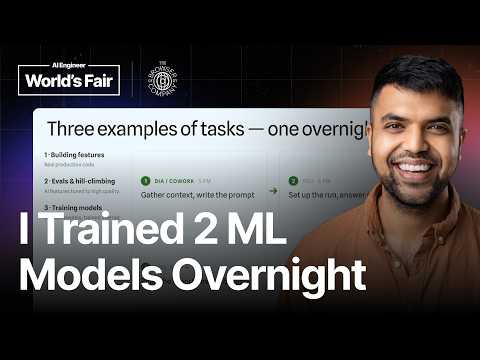
Fifteen recurring meetings a week, seven direct reports, a toddler at home, and somewhere inside that Hursh Agrawal ships between two and ten pull requests. It was not possible a year ago.
 Play video
If you are shipping AI generated code faster than your humans can review it, Itamar Friedman's position is that you are inside the problem rather than ahead of it.
 Play video
In 2009 people told Patrick Debois that continuous delivery was crazy. He hears the same thing now about the dark factory, and reads it the same way: not that the technology cannot work, but that the organization is not set up for it yet.